
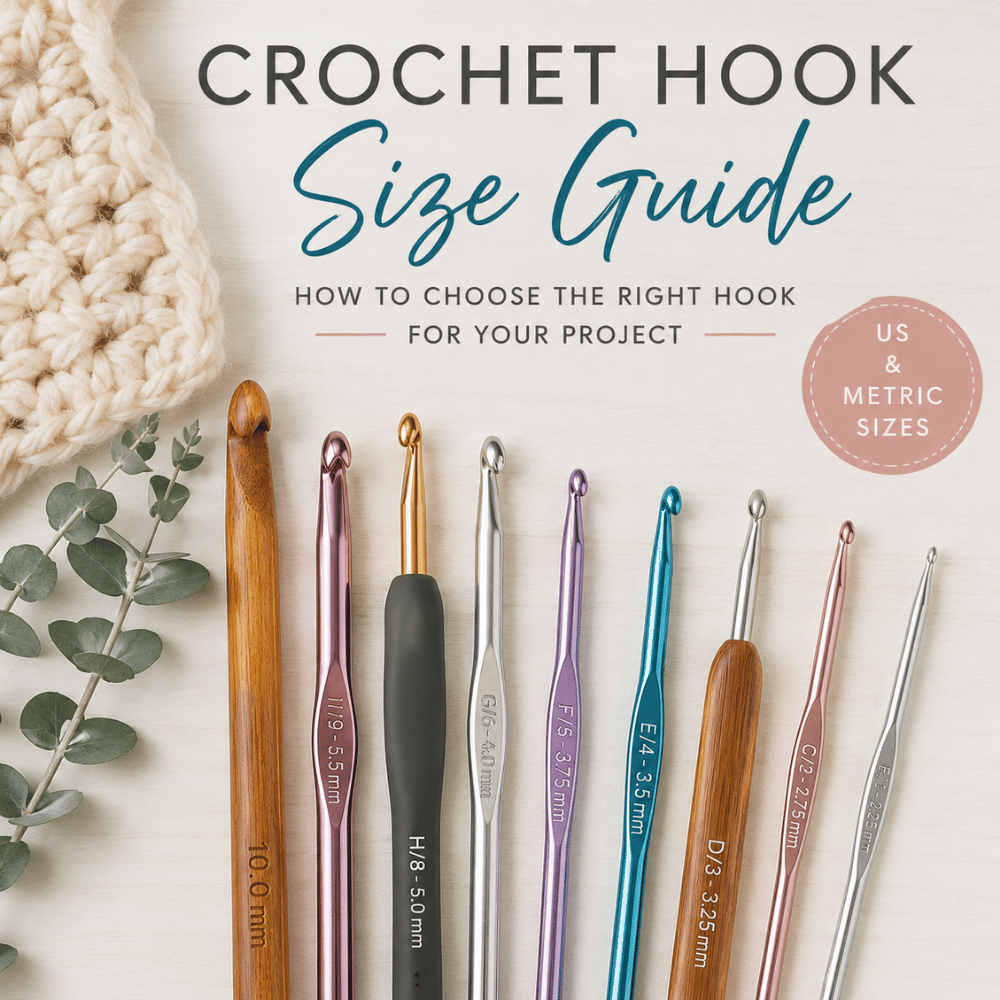
Choosing the right crochet hook size can make a huge difference in how your finished project looks and feels. Your hook affects everything from gauge and tension to the overall texture and drape of your crochet fabric.
With so many crochet hook sizes available, knowing which one to grab can feel a little confusing—especially when the yarn label recommends one size and your crochet pattern recommends another!
The good news is that choosing a crochet hook doesn’t have to be complicated. In this guide, I’ll explain how crochet hook sizes work, how to match your hook to your yarn and pattern, and why sometimes changing your hook size is exactly what you need to get the perfect result.
Understanding Crochet Hook Sizes
Crochet hooks come in many different sizes, ranging from tiny steel hooks used for crochet thread to much larger hooks designed for bulky and super bulky yarn.
The crochet hook size refers to the diameter of the hook, which is usually measured in millimeters.
For example:
- 4.0 mm
- 5.0 mm
- 5.5 mm
- 6.0 mm
- 8.0 mm
- 10.0 mm
Generally, a smaller hook creates smaller, tighter stitches, while a larger hook creates bigger, looser stitches.
However, your personal tension also plays an important role. Two crocheters can use the exact same yarn and crochet hook size and still end up with slightly different results.
That’s completely normal!
US Crochet Hook Sizes vs. Metric Sizes
Depending on where you live, crochet hooks may be labeled with a metric measurement, a US letter or number, or both.
For example, you may see a hook labeled:
5.0 mm / H-8
The millimeter measurement tells you the actual diameter of the hook, while H-8 is the corresponding US crochet hook size.
Because sizing systems can vary slightly between manufacturers, I personally like to pay attention to the millimeter measurement whenever possible.
It gives you a much clearer way to compare crochet hook sizes from one brand to another.

Start With Your Crochet Pattern
If you’re following a crochet pattern, start with the crochet hook size recommended by the designer.
The designer chose that hook based on the yarn, stitch pattern, gauge, and finished fabric used to create the original project.
However, that doesn’t necessarily mean you’ll end up using the same hook.
Why?
Because we all crochet a little differently.
Some of us naturally crochet tightly, while others have a much looser tension. The recommended crochet hook size is therefore a starting point.
Your gauge will tell you whether it’s actually the right size for you.
If you’re newer to written patterns, you can also check out my How to Read a Crochet Pattern for Beginners guide for help understanding materials, gauge, abbreviations, repeats, stitch counts, and pattern notes.
Check the Yarn Label
If you’re not following a specific crochet pattern, the yarn label is a great place to start.
Most yarn labels include a recommended crochet hook size along with information such as:
- Yarn weight
- Fiber content
- Yardage
- Care instructions
- Crochet gauge
- Knitting needle size
- Dye lot or color information
The recommended hook gives you a general idea of which size works well with that particular yarn.
However, just like the hook listed in a crochet pattern, the hook size on a yarn label is a recommendation—not a rule.
You may need a smaller or larger hook depending on the stitch you’re using and the type of fabric you want to create.
For more yarn tips, you can also check out my How to Choose the Right Yarn for Crochet Garments guide.

Match Your Crochet Hook Size to the Yarn Weight
As a general rule, thinner yarns are paired with smaller crochet hooks, while thicker yarns are paired with larger hooks.
For example, a lightweight yarn will usually require a much smaller hook than a bulky or super bulky yarn.
But yarn weight is only part of the equation.
Two yarns labeled as the same weight can still have very different thicknesses, textures, and fiber content. One #4 worsted-weight yarn may feel noticeably thicker than another.
That’s why I don’t recommend choosing a crochet hook based on the yarn weight number alone.
Use the yarn label and pattern recommendation as your starting point, then look at your actual crochet fabric.
How Crochet Hook Size Changes Your Fabric
This is one of the most important things to understand when choosing your hook.
Using a Smaller Crochet Hook
A smaller hook generally creates:
- Smaller stitches
- Tighter fabric
- Less drape
- A firmer structure
- More stitches within the same measurement
This can be helpful for projects where you want a sturdy fabric.
For example, I sometimes use a smaller hook with crochet bags because I want the fabric to be tighter and hold its shape rather than stretch too much.
Using a Larger Crochet Hook
A larger hook generally creates:
- Larger stitches
- Looser fabric
- More drape
- A softer feel
- Fewer stitches within the same measurement
That can work beautifully for garments where you want the fabric to move and drape comfortably.
The goal isn’t necessarily to use the hook size printed on the yarn label. The goal is to create the fabric your project needs.
Crochet Hook Size and Gauge
This is where crochet hook size becomes especially important.
If you’re making a garment, hat, or another project where finished measurements matter, always check your gauge.
Let’s say the pattern calls for:
14 sts = 4″
You make your gauge swatch using the recommended crochet hook, but you have 16 stitches within 4 inches.
Your stitches are too small.
Try going up a hook size and make another swatch.
On the other hand, if you only have 12 stitches within 4 inches, your stitches are too large. Try going down a hook size.
Continue adjusting until your gauge matches the pattern as closely as possible.
This is why the hook listed in the pattern is only a starting point. The hook that gives you the correct gauge is the right hook for you.
If gauge still feels a little confusing, check out my How to Check Gauge for a Crochet Sweater guide. I walk you through making and measuring your swatch and explain why gauge is so important for getting the right fit.

Don’t Forget About Row Gauge
We often concentrate on stitch gauge, but row gauge matters too.
Changing your crochet hook size can affect both the width and height of your stitches.
This can be especially important when making garments where the number of rows determines the length or width of a section.
Always check both stitch and row gauge when the pattern provides them.
And most importantly, make that gauge swatch!
It takes a little extra time at the beginning, but it’s much easier to change your crochet hook after a small swatch than after you’ve already crocheted half a sweater.
Your Crochet Tension Matters
Your tension is simply how tightly or loosely you hold and work your yarn as you crochet.
If you naturally crochet tightly, you may find yourself going up a crochet hook size to meet gauge.
If you naturally crochet loosely, you may need to go down a hook size.
Neither is wrong.
This is exactly why two people following the same crochet pattern with the same yarn don’t necessarily need the same hook.
Rather than trying to force yourself to crochet tighter or looser throughout an entire project, I usually think it’s much easier to adjust the crochet hook size.
You want to crochet comfortably and consistently.

Different Crochet Hook Materials
Crochet hooks aren’t only available in different sizes. They’re also made from different materials.
Some common options include:
Aluminum Crochet Hooks
Aluminum hooks are lightweight, smooth, and widely available. Yarn usually glides easily across the hook, making them a great everyday option.
Ergonomic Crochet Hooks
Ergonomic hooks have larger, softer handles designed to make the hook more comfortable to hold.
If you crochet for long periods, you may prefer the feel of an ergonomic handle.
Bamboo and Wooden Crochet Hooks
Wood and bamboo have a little more grip than smooth metal hooks.
That extra grip can be useful when you’re working with a yarn that tends to slide around.
Acrylic or Resin Crochet Hooks
These hooks come in lots of fun colors and designs and are often available in larger sizes.
Ultimately, the best crochet hook material comes down to what feels comfortable in your hand and works well with your yarn.

Does Crochet Hook Shape Matter?
You may also notice that crochet hooks have slightly different head shapes.
The two common styles are generally referred to as inline and tapered hooks.
Some crocheters strongly prefer one over the other, while others switch between them without giving it much thought.
There’s no right or wrong choice.
Try different hooks and see which shape feels most natural with the way you hold your hook and work your stitches.
When Should You Change Crochet Hook Size?
There are several situations where changing your hook makes sense.
Consider changing your crochet hook size when:
- Your gauge doesn’t match the pattern
- Your fabric feels too stiff
- Your stitches are too loose
- Your project is turning out too large or small
- You’re substituting a different yarn
- You want more or less drape
- You’re struggling to insert your hook comfortably into the stitches
Don’t be afraid to experiment.
Sometimes changing by only 0.5 mm can make a noticeable difference.

Keep Your Crochet Hook Size Consistent
Once you’ve found the correct hook for your project, make sure you keep using the same size.
If you’re putting your project away for a while, write down the crochet hook size you’re using or keep a note with the project.
Trust me—it’s surprisingly easy to come back to a project a few weeks later and wonder which hook you were using!
I also like to keep the hook with the project whenever possible.
Common Crochet Hook Size Mistakes
One of the biggest mistakes is assuming you must use the crochet hook listed on the yarn label or in the pattern.
Remember, those sizes are starting points.
Another common mistake is changing hook sizes without checking the new gauge.
If you change your hook, make another swatch—especially for a garment.
And don’t forget that changing your yarn can also change your gauge, even when the replacement yarn has the same weight number.
I’ve also put together 10 Common Crochet Mistakes and How to Fix Them with more helpful tips for avoiding some of the most common crochet frustrations.
Choosing the Right Crochet Hook Size
Choosing the right crochet hook size really comes down to three things:
Your yarn + your pattern + your tension.
Start with the recommended hook, make a gauge swatch, and then adjust your hook size if needed.
Pay attention to how the fabric looks and feels too. Gauge may tell you whether the finished measurements will be correct, but you still want to love the texture and drape of the fabric you’re creating.
With a little practice, choosing a crochet hook becomes much more intuitive.
More Crochet Tips & Tutorials
If you found this guide helpful, explore more of my Learn to Crochet tutorials for tips that can make your next project easier and more enjoyable.
You can learn more about checking gauge, choosing yarn, reading crochet patterns, and fixing common crochet mistakes—all little things that can make a huge difference in your finished projects.
Whether you’re working on your first crochet project or your next handmade sweater, understanding your yarn, hook, and gauge will help you start with confidence and enjoy the process from beginning to end.