
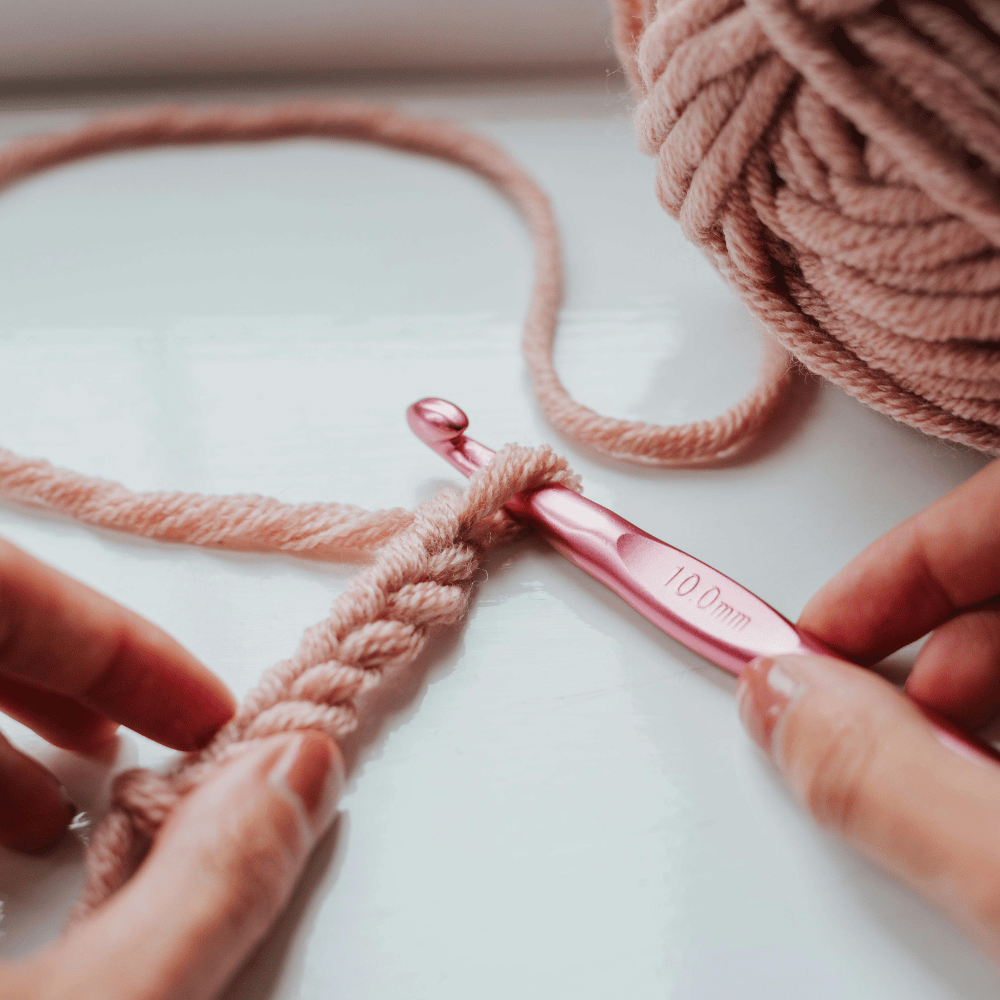
We’ve all been there. You’re happily crocheting along, feeling pretty good about your project, and then you look down and realize something just doesn’t look right.
Maybe your sweater isn’t measuring correctly. Your rectangle is slowly turning into a triangle. Your stitch count has mysteriously changed. Or that nice flat project suddenly starts curling.
Don’t worry! Common crochet mistakes happen to everyone, whether you’re working on your first project or you’ve been crocheting for years. The good news is that most mistakes are easy to fix once you know what to look for.
In this guide, I’m sharing 10 common crochet mistakes, why they happen, and, most importantly, how to fix them before they affect your entire project.
1. Skipping the Gauge Swatch

I know, I know. You have your yarn, your hook, and a new crochet pattern you’re excited to start. The last thing you want to do is make a little square first.
However, if you’re making a crochet sweater, cardigan, beanie, or anything that needs to fit, don’t skip your gauge swatch!
So, what exactly is gauge?
Crochet gauge is the measurement of how many stitches and rows fit within a specific area, usually 4″ x 4″. Your gauge can change depending on your yarn, hook size, stitch, and tension. Even if you use the exact yarn and hook recommended in the pattern, your gauge may differ because everyone crochets a little differently.
Gauge is especially important when making garments and other fitted projects. Even a small difference can add up quickly across an entire project. As a result, your finished sweater, cardigan, or beanie could end up too big, too small, too long, or too short.
How to Fix It
Make a gauge swatch using the yarn and hook you plan to use for your project. I recommend making your swatch at least 6″ x 6″, which gives you plenty of room to accurately measure your stitches and rows from the center of the swatch.
If you have too many stitches within the measurement, your stitches are too small. Try going up a hook size.
If you have too few stitches, your stitches are too large. Try going down a hook size.
Remember, matching the pattern gauge is more important than using the exact hook size listed in the pattern.
A few extra minutes checking your gauge can save you hours of frogging later!
You can also check out my blog, How to Check Gauge for a Crochet Sweater, for helpful tips on getting the right gauge and the perfect fit!
2. Not Counting Your Stitches

Counting stitches isn’t exactly the most exciting part of crocheting.
However, it’s one of the easiest ways to catch a mistake before it becomes a bigger problem.
This is especially important when you’re working increases, decreases, shaping, granny squares, garments, or projects worked in the round.
How to Fix It
Get into the habit of checking your stitch count regularly.
You don’t necessarily need to count every single row throughout the entire project. However, when you’re learning a new stitch or starting a new section, counting more frequently can make a huge difference.
Also, pay attention whenever a crochet pattern gives you a stitch count at the end of a row or round.
That number is there for a reason!
Think of it as a little checkpoint telling you that you’re still on track.
3. Your Crochet Project Keeps Getting Wider

You started with a nice straight edge, but a few rows later, your project seems to be growing.
Accidentally adding stitches is one of the common crochet mistakes that can quickly change the shape of your project.
The extra stitches often sneak in at the beginning or end of a row.
Turning chains can also be confusing because some crochet patterns count them as a stitch while others don’t.
How to Fix It
First, check the pattern instructions to see whether the turning chain counts as a stitch.
Then, count your stitches after each row until you become comfortable with the stitch pattern.
You can also place a stitch marker in the first and last stitch of your row. This makes those stitches much easier to recognize when you come back to them.
If your stitch count keeps increasing, you’ll know you’re accidentally adding stitches somewhere.
A couple of stitch markers can save you a whole lot of frogging!
4. Your Crochet Project Keeps Getting Smaller

The opposite problem can happen too.
If your project is becoming narrower with every row, you’re probably skipping stitches.
Again, the first and last stitches are usually the culprits because they can be harder to see.
How to Fix It
Stitch markers are your friend.
Place one in the first stitch and another in the last stitch. Then, move them up as you complete each row.
Also, count your stitches regularly.
If your pattern says you should have 40 stitches and suddenly you only have 38, stop and find those missing stitches before continuing.
It’s much easier to frog one row than ten!
5. Your Crochet Tension Is Too Tight

Tension is another important part of avoiding common crochet mistakes, especially when you’re making garments or accessories that need to fit.
If you’re struggling to insert your hook into the stitches, your hands are getting tired, or your finished fabric feels stiff, your tension may be too tight.
Tight tension can also make your finished project smaller than expected.
How to Fix It
Try relaxing your grip on both the crochet hook and yarn.
You don’t need to pull every stitch tight after making it. Instead, let the hook help determine the size of your loops.
You can also try going up a crochet hook size.
Most importantly, your stitches should feel comfortable to work into. With practice, your tension will usually become more natural and consistent.
6. Your Crochet Tension Is Too Loose

Loose tension can create the opposite problem.
Your stitches may look uneven, the fabric may have large gaps, and your finished project could end up bigger than expected.
This can be especially noticeable when crocheting sweaters, beanies, or bags.
How to Fix It
Try going down a crochet hook size.
Also, pay attention to how you’re holding your working yarn. Keeping a little more control over the yarn can help create more consistent stitches.
However, don’t pull everything extremely tight to compensate.
The goal is consistent tension, not tight tension.
7. Using the Wrong Yarn

You find a beautiful crochet pattern but don’t have the recommended yarn.
So, you grab something from your stash that looks close enough.
Sometimes it works perfectly.
Other times…not so much.
Two yarns labeled as the same weight can still behave very differently. Fiber content, thickness, texture, stretch, and elasticity can all affect your finished project.
This is especially important when substituting yarn for a crochet garment.
How to Fix It
When substituting yarn, don’t look at yarn weight alone.
Compare the fiber content, recommended hook size, yardage, and thickness of the yarn.
Then, make a gauge swatch when sizing matters.
Also, look at the actual fabric you’re creating.
Does it have enough drape for a cardigan? Is it sturdy enough for a crochet bag? Does it feel comfortable against your skin?
Choosing the right yarn can completely change how your finished crochet project looks and feels.
I created both the Brooklyn Bag and Chloe Bag using T-shirt yarn, then made them again with Lion Brand Cover Story Lazy Days. Both yarns worked out great!
However, always make sure to swatch before substituting yarn, since different yarns can change the size, texture, and overall look of your finished project.
8. Crocheting Into the Wrong Loop

Front loop, back loop, third loop, both loops…crochet patterns can have you putting your hook just about everywhere!
Working into the wrong loop is one of those common crochet mistakes that may seem small but can completely change the appearance and texture of your project.
It can also affect your gauge.
How to Fix It
Before beginning a new stitch pattern, take a minute to identify the top of your crochet stitch.
The top usually looks like a small V.
The loop closest to you is the front loop, while the loop farther away is the back loop.
Some stitches also have a third loop that sits behind or in front of the traditional V.
If the pattern doesn’t specify a particular loop, you’ll generally work under both loops of the stitch.
Once you learn how to recognize the different loops, following crochet patterns becomes much easier.
9. Losing the Beginning of the Round

Working in the round is great until you suddenly ask yourself:
Wait…where did this round start?
This happens especially when you’re crocheting in continuous or spiral rounds because there isn’t a visible join marking the end of each round.
Before you know it, you can lose track of your increases, decreases, or stitch count.
How to Fix It
Use a stitch marker!
I like to place a marker in my first stitch so I don’t lose it. It’s totally optional, but it’s a habit of mine that makes working in rounds much easier.
When you reach the marker again, you’ll know you’ve completed the round.
Then, simply move the marker up into the first stitch of the next round.
Easy!
Check out my Tigerlily Tote and matching Tigerlily Bucket Hat, where I worked in the round to create the African Flower Granny Squares!
10. Not Reading the Entire Crochet Pattern First
We’ve all gotten excited about a new crochet project and immediately grabbed our yarn.
However, reading through the pattern first can prevent a lot of confusion later.
You may discover that you need a special stitch, additional materials, stitch markers, buttons, a zipper, or another hook size.
There may also be important notes about construction that make the instructions much easier to understand.
How to Fix It
Before starting, quickly read through the entire crochet pattern.
You don’t need to memorize it!
Instead, look over the construction, abbreviations, special stitches, materials, gauge, sizing, and pattern notes.
If there’s a stitch you haven’t used before, practice it on a small swatch.
Also, if you’re more of a visual learner, check whether the pattern includes a video tutorial. Seeing the stitch or construction worked step by step can make everything click much faster.
How to Avoid Common Crochet Mistakes

The easiest way to avoid common crochet mistakes is to slow down, especially when you’re learning a new stitch or starting a new pattern.
First, make your gauge swatch when sizing matters. Then, keep a few stitch markers nearby and count your stitches regularly.
It also helps to stop occasionally and look at your work.
Are your edges straight?
Does the stitch pattern look consistent?
Is your project measuring approximately what it should?
Do you still have the correct number of stitches?
Catching a problem after one or two rows is much easier than discovering it after you’ve crocheted half the project.
Don’t Be Afraid to Frog Your Crochet

If you’re new to crochet, you may hear crocheters talking about “frogging.”
No, we’re not adding little crochet frogs to every project!
Frogging simply means pulling out your stitches and reworking a section.
And yes, sometimes it’s frustrating.
However, every crocheter does it.
Finding a mistake doesn’t mean the entire project is ruined. Usually, you just need to go back a little, correct the problem, and continue.
The sooner you catch the mistake, the easier it will be to fix.
Common Crochet Mistakes Are Part of Learning
Even experienced crocheters occasionally miss a stitch, grab the wrong hook, lose count, or crochet several rows before realizing something doesn’t look quite right.
It happens!
The more you crochet, the easier it becomes to recognize common crochet mistakes before they turn into bigger problems.
So, make that gauge swatch, keep your stitch markers close, count those stitches, and don’t be afraid to frog a row when you need to.
Most importantly, have fun with it.
Every mistake you figure out teaches you something new. Before you know it, you’ll be spotting those little crochet problems before they even have a chance to become big ones!